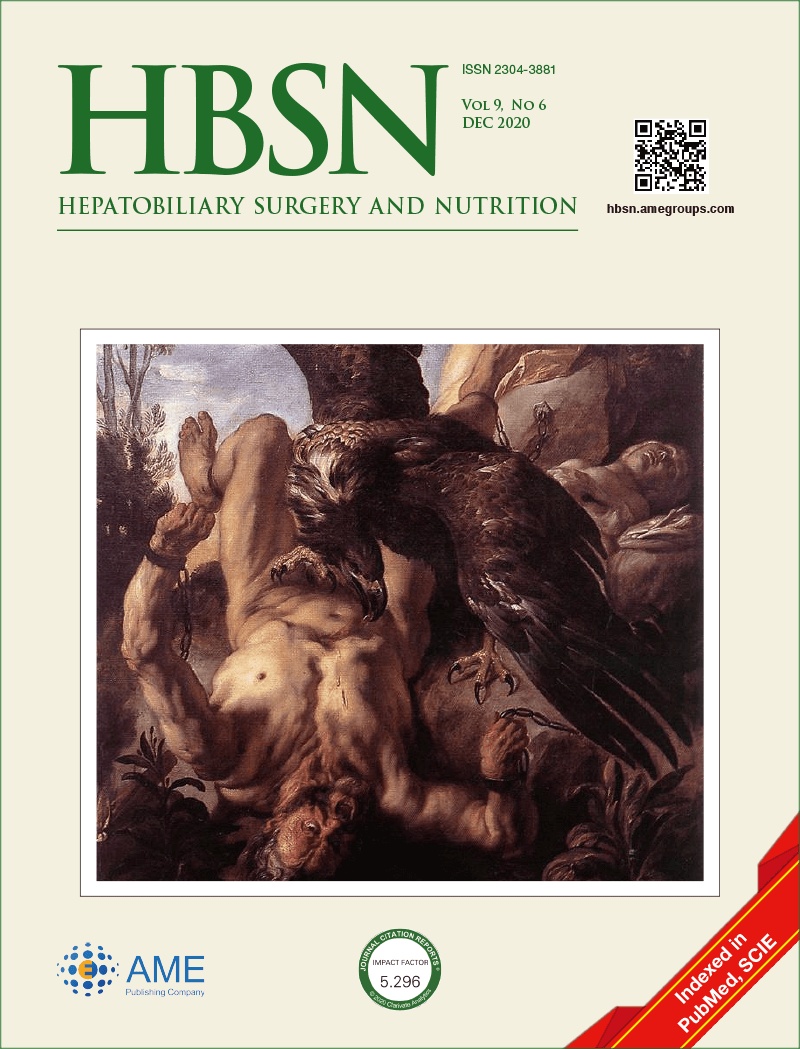
The Story Behind the Cover Picture
The myth of Prometheus depicted by Jacob Jordaens in 1640
HepatoBiliary Surgery and Nutrition
2020;
9
(6)
:693
.
(01 December 2020)

Review Article on Colorectal Cancer Liver Metastasis1
The role of associating liver partition and portal vein ligation for staged hepatectomy in the management of patients with colorectal liver metastasis
HepatoBiliary Surgery and Nutrition
2020;
9
(6)
:694-704
.
(01 December 2020)
Impact and clinical usefulness of genetic data in the surgical management of colorectal cancer liver metastasis: a narrative review
HepatoBiliary Surgery and Nutrition
2020;
9
(6)
:705-716
.
(01 December 2020)
This non-systematic review presents evidence that genetic data can be used intraoperatively to tailor surgical margin width and technique, as well as to inform post-hepatectomy surveillance. Current evidence does not support the use of genetic data to guide selection of patients for surgery.
Original Article
A new classification for hepatocellular carcinoma with hepatic vein tumor thrombus
HepatoBiliary Surgery and Nutrition
2020;
9
(6)
:717-728
.
(01 December 2020)
A new classification was established to predict prognosis of HCC patients with hepatic vein tumor thrombus (HVTT) who underwent different treatments. This classification was superior to, and it may serve as a supplement to, the commonly used staging systems.
The benefit of curative liver resection with a selective bile duct preserving approach for hepatocellular carcinoma with macroscopic bile duct tumor thrombus
HepatoBiliary Surgery and Nutrition
2020;
9
(6)
:729-738
.
(01 December 2020)
HCC with bile duct tumor thrombus (BDTT) was relatively presentation. However, the results of our study indicate that it was not an end-stage condition. In selected patients, major liver resection with a selective bile duct preservation approach showed comparable long-term outcomes with a non-BDTT group.
Clear mortality gap caused by graft macrosteatosis in Chinese patients after cadaveric liver transplantation
HepatoBiliary Surgery and Nutrition
2020;
9
(6)
:739-758
.
(01 December 2020)
It is still unclear for the quantified risk of graft steatosis on prognosis for Chinese patients after liver transplantation. Our study found the Chinese recipients seemed more susceptive to the risk of macrosteatosis (MaS), and risk threshold of graft MaS can be lowered to 10%.
Robotic-assisted versus open total pancreatectomy: a propensity score-matched study
HepatoBiliary Surgery and Nutrition
2020;
9
(6)
:759-770
.
(01 December 2020)
Total pancreatectomy is a complex procedure with a significant impact in patient quality of life. In this study, the utilization of a robotic approach in 15 patients demonstrated decrease in median operative time and postoperative length of stay compared to the classic open approach with similar rates of postoperative complications.
Editorial
Diagnosis-related Groups (DRG) pricing and payment policy in China: where are we?
HepatoBiliary Surgery and Nutrition
2020;
9
(6)
:771-773
.
(01 December 2020)
Metabolic associated fatty liver disease and cancer risk: causal role or epiphenomenon?
HepatoBiliary Surgery and Nutrition
2020;
9
(6)
:774-776
.
(01 December 2020)
Promising anticancer therapy: combination of immune checkpoint inhibitors and molecular-targeted agents
HepatoBiliary Surgery and Nutrition
2020;
9
(6)
:777-779
.
(01 December 2020)
Management of recurrent hepatocellular carcinoma after resection
HepatoBiliary Surgery and Nutrition
2020;
9
(6)
:780-783
.
(01 December 2020)
Clinical impact of omega-3 fatty acids (Ω3 FA) supplementation on liver surgery
HepatoBiliary Surgery and Nutrition
2020;
9
(6)
:784-787
.
(01 December 2020)
Three-dimensional bioprinted liver tissue for transplantation: hope or hype?
HepatoBiliary Surgery and Nutrition
2020;
9
(6)
:788-790
.
(01 December 2020)
A new tool for estimating liver cancer risk after a hepatitis C virus cure
HepatoBiliary Surgery and Nutrition
2020;
9
(6)
:791-793
.
(01 December 2020)
Targeting tumor microenvironment as a treatment strategy for hepatocellular carcinoma
HepatoBiliary Surgery and Nutrition
2020;
9
(6)
:794-796
.
(01 December 2020)
Assessing resectability for colorectal liver metastases: agreeing that we disagree
HepatoBiliary Surgery and Nutrition
2020;
9
(6)
:797-800
.
(01 December 2020)
When a new definition overhauls perceptions of MAFLD related cirrhosis care
HepatoBiliary Surgery and Nutrition
2020;
9
(6)
:801-804
.
(01 December 2020)
Viewpoint
Does the laparoscopic approach for liver resections for colorectal liver metastasis truly confer improved survival outcomes?
HepatoBiliary Surgery and Nutrition
2020;
9
(6)
:805-808
.
(01 December 2020)
Conversion surgery for hepatocellular carcinoma in the new era of targeted and immune checkpoint inhibitor therapies
HepatoBiliary Surgery and Nutrition
2020;
9
(6)
:809-811
.
(01 December 2020)
Letter to the Editor
Not yet IDEAL?—evidence and learning curves of minimally invasive pancreaticoduodenectomy
HepatoBiliary Surgery and Nutrition
2020;
9
(6)
:812-814
.
(01 December 2020)
Automated quantification of fibrosis-related parameters using dual-photon microscopy replace diagnosis of pathologists in NAFLD
HepatoBiliary Surgery and Nutrition
2020;
9
(6)
:815-816
.
(01 December 2020)
Prevent bile duct injury by indocyanine green guide fluorescent imaging during laparoscopic cholecystectomy in liver transplantation recipient
HepatoBiliary Surgery and Nutrition
2020;
9
(6)
:817-819
.
(01 December 2020)
Images in Clinical Medicine2
A case of duodenal Brunner’s gland adenoma
HepatoBiliary Surgery and Nutrition
2020;
9
(6)
:820-821
.
(01 December 2020)
Disclosure:
1. The series “Colorectal Cancer Liver Metastasis” was commissioned by the editorial office, Hepatobiliary Surgery and Nutrition without any sponsorship or funding. Timothy M. Pawlik served as the unpaid Guest Editor for the series.
2. The series “Images in Clinical Medicine” was commissioned by the editorial office, Hepatobiliary Surgery and Nutrition without any sponsorship or funding.