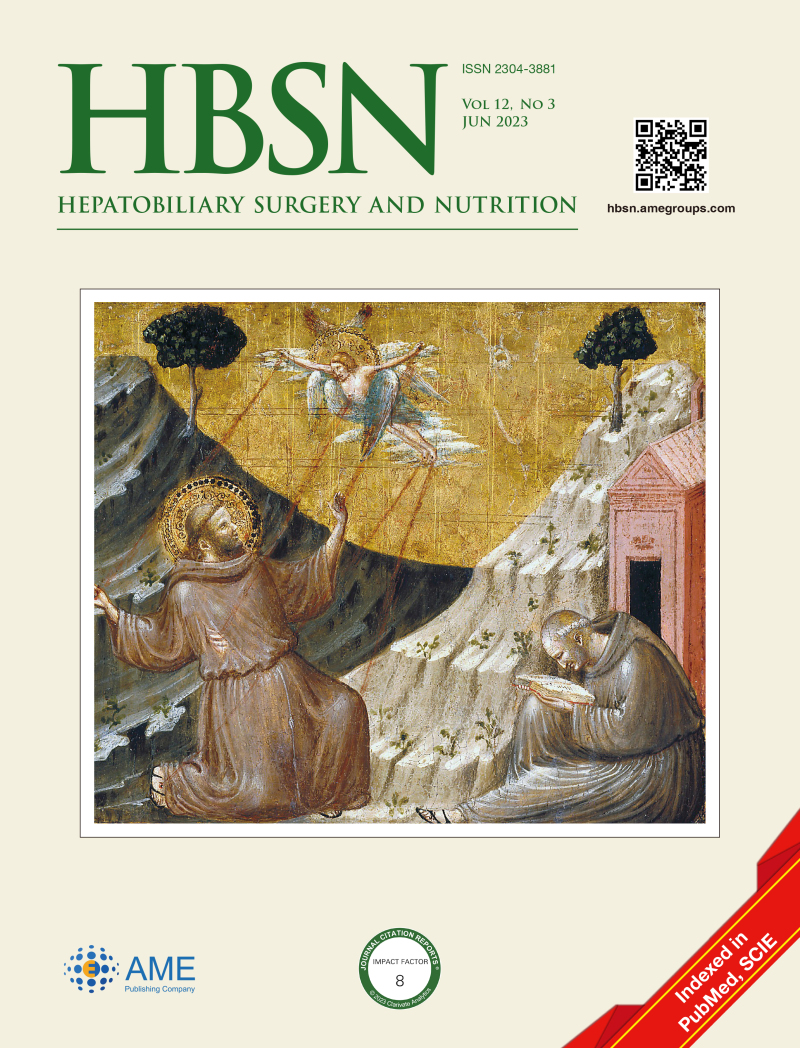
The Story Behind the Cover Picture
St. Francis of Assisi receives the stigma on his liver
HepatoBiliary Surgery and Nutrition
2023;
12
(3)
:300-301
.
(01 June 2023)

Original Article
Targeted deep sequencing reveals the genetic heterogeneity in well-differentiated pancreatic neuroendocrine tumors with liver metastasis
HepatoBiliary Surgery and Nutrition
2023;
12
(3)
:302-313
.
(01 June 2023)
The intratumor, intraindividual, and interindividual heterogeneity in pNET patients were discovered through the targeted deep sequencing in the surgically resected pNET and paired liver metastatic samples, which brought potential challenges for the current biopsy strategies in guiding the clinical treatments.
Association of tumor morphology with long-term prognosis after liver resection for patients with a solitary huge hepatocellular carcinoma—a multicenter propensity score matching analysis
HepatoBiliary Surgery and Nutrition
2023;
12
(3)
:314-327
.
(01 June 2023)
This large-scale multicenter study demonstrated that preoperative imaging tumor morphology was associated with prognosis following resection for a solitary huge HCC. Patients with balloon-shaped HCCs had better overall survival and recurrence-free survival than patients with non-balloon-shaped HCCs after hepatectomy.
Impact of pure laparoscopic surgery on bile duct division of living donor left lateral section procurement
HepatoBiliary Surgery and Nutrition
2023;
12
(3)
:328-340
.
(01 June 2023)
A high frequency of multiple bile ducts was found in a sample of 74 laparoscopic left lateral section liver procurements as compared with 106 in open surgery left lateral section liver procurements. Use of routine X-ray based intraoperative cholangiography may help to reduce this problem.
Adipose tissue induces a better liver regeneration after living liver donation in normal weight donors
HepatoBiliary Surgery and Nutrition
2023;
12
(3)
:341-350
.
(01 June 2023)
Regenerating liver hepatocytes normally accumulate fat microdroplets. The extrahepatic adipose tissue could be an important factor affecting liver regeneration after partial hepatectomy. In this study, we found that living donors with a higher fat mass index had a better liver volume gain after surgery.
Large, multifocal or portal vein-invading hepatocellular carcinoma (HCC) downstaged by Y90 using personalized dosimetry: safety, pathological results and outcomes after surgery
HepatoBiliary Surgery and Nutrition
2023;
12
(3)
:351-365
.
(01 June 2023)
Our study showed that Y90 TARE using personalized dosimetry can provide high rates of imaging and pathological response in patients with PVTT, large or multifocal HCC. Subsequent surgery is safe and leads to outcomes that far exceed expectations in a population with an otherwise poor prognosis and no chance for cure.
Review Article
The Hong Kong consensus statements on unresectable hepatocellular carcinoma: narrative review and update for 2021
HepatoBiliary Surgery and Nutrition
2023;
12
(3)
:366-385
.
(01 June 2023)
These statements summarize expert opinion on the treatment of hepatocellular carcinoma, including the use of surgical, transarterial, ablative, radiotherapeutic and systemic modalities. This update has seen additions guiding the use of targeted therapies and immunotherapies due to the availability of new data.
Expert Consensus
An international Delphi consensus statement on metabolic dysfunction-associated fatty liver disease and risk of chronic kidney disease
HepatoBiliary Surgery and Nutrition
2023;
12
(3)
:386-403
.
(01 June 2023)
Using a Delphi-based approach, a multidisciplinary panel of 50 international experts from 26 countries reached a consensus on epidemiology, mechanisms, management and treatment between MAFLD and CKD, to provide a framework for the development of appropriate guidance on CKD in individuals with MAFLD.
French Editorial Commentary from the ACHBPT
Feasibility, safety and limits of robotic approach for lymphadenectomy in biliary tumours
HepatoBiliary Surgery and Nutrition
2023;
12
(3)
:404-406
.
(01 June 2023)
Editorial Commentary
The difficulty of medical decision-making: should patients be involved?
HepatoBiliary Surgery and Nutrition
2023;
12
(3)
:407-409
.
(01 June 2023)
Bleeding risk and thrombosis in cirrhosis: a paradox with a need to address them
HepatoBiliary Surgery and Nutrition
2023;
12
(3)
:410-412
.
(01 June 2023)
How will the latest modifications to the CG189 NICE guidelines for obesity management likely impact clinical care?
HepatoBiliary Surgery and Nutrition
2023;
12
(3)
:413-416
.
(01 June 2023)
Sarcopenic obesity: recent consensus and clinical implications in patients with chronic liver disease
HepatoBiliary Surgery and Nutrition
2023;
12
(3)
:417-420
.
(01 June 2023)
Screening for pancreatic cancer in individuals with genetic susceptibility
HepatoBiliary Surgery and Nutrition
2023;
12
(3)
:421-423
.
(01 June 2023)
Liver transplantation for non-resectable colorectal metastases—an evolving paradigm in transplant oncology
HepatoBiliary Surgery and Nutrition
2023;
12
(3)
:424-427
.
(01 June 2023)
Pancreatic exocrine insufficiency guidelines: more questions than answers!
HepatoBiliary Surgery and Nutrition
2023;
12
(3)
:428-430
.
(01 June 2023)
Proposal of definition and diagnostic criteria for sarcopenic obesity by ESPEN and EASO
HepatoBiliary Surgery and Nutrition
2023;
12
(3)
:431-434
.
(01 June 2023)
Adjuvant atezolizumab-bevacizumab after curative therapy for hepatocellular carcinoma
HepatoBiliary Surgery and Nutrition
2023;
12
(3)
:435-439
.
(01 June 2023)
Time-restricted feeding: what we have done and what more we can do?
HepatoBiliary Surgery and Nutrition
2023;
12
(3)
:440-442
.
(01 June 2023)
Editorial
Resection vs. transplantation for hepatocellular carcinoma: a never ending challenge
HepatoBiliary Surgery and Nutrition
2023;
12
(3)
:443-446
.
(01 June 2023)
Hepatic inflammation: an important target for biomarker development in nonalcoholic fatty liver disease
HepatoBiliary Surgery and Nutrition
2023;
12
(3)
:447-449
.
(01 June 2023)
β-cryptoxanthin and fatty liver disease: new insights
HepatoBiliary Surgery and Nutrition
2023;
12
(3)
:450-452
.
(01 June 2023)
Development of conversion therapy for advanced hepatocellular carcinoma
HepatoBiliary Surgery and Nutrition
2023;
12
(3)
:453-456
.
(01 June 2023)
The promise of precision medicine: how biomarkers are shaping the future of cholangiocarcinoma treatment
HepatoBiliary Surgery and Nutrition
2023;
12
(3)
:457-461
.
(01 June 2023)
Qualifying the suitability of living donor livers for pediatric liver transplantation: are we doing the right thing?
HepatoBiliary Surgery and Nutrition
2023;
12
(3)
:462-464
.
(01 June 2023)
Preservation of aberrant right hepatic artery during pancreaticoduodenectomy
HepatoBiliary Surgery and Nutrition
2023;
12
(3)
:465-467
.
(01 June 2023)
Letter to the Editor
Multikinase inhibitor-based immunotherapy doublet for advanced hepatocellular carcinoma: its efficacy still needs to be determined
HepatoBiliary Surgery and Nutrition
2023;
12
(3)
:468-471
.
(01 June 2023)
Is transarterial embolization plus two-stage hepatectomy the optimal strategy for the treatment of spontaneous rupture of hepatocellular carcinoma?
HepatoBiliary Surgery and Nutrition
2023;
12
(3)
:472-474
.
(01 June 2023)
Revision and addendum to the manuscript titled “Propensity score matching study of 325 patients with spontaneous rupture of hepatocellular carcinoma”
HepatoBiliary Surgery and Nutrition
2023;
12
(3)
:475-477
.
(01 June 2023)