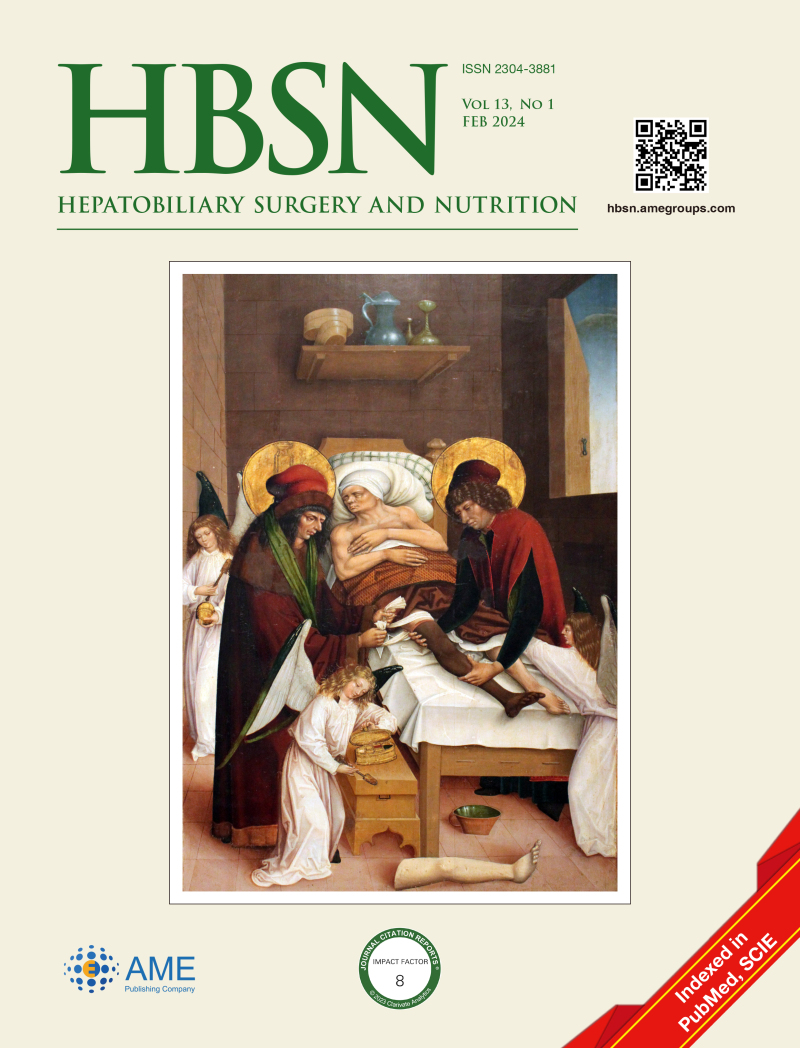
The Story Behind the Cover Picture
The miracle transplantation of a black leg by the surgeon saints Cosmas and Damian
HepatoBiliary Surgery and Nutrition
2024;
13
(1)
:1-2
.
(01 February 2024)

Original Article
Prevalence, patterns, risk factors and outcomes of peritoneal metastases after laparoscopic hepatectomy for hepatocellular carcinoma: a multicenter study from China
HepatoBiliary Surgery and Nutrition
2024;
13
(1)
:3-15
.
(01 February 2024)
Laparoscopic hepatectomy was not associated with increased prevalence of peritoneal metastases in hepatocellular carcinoma patients for experienced surgeons. Surgical re-excision of peritoneal metastases could benefit long term survival.
Grading severity of microscopic vascular invasion was independently associated with recurrence and survival following hepatectomy for solitary hepatocellular carcinoma
HepatoBiliary Surgery and Nutrition
2024;
13
(1)
:16-28
.
(01 February 2024)
Review Article
Molecular pathology for cholangiocarcinoma: a review of actionable genetic targets and their relevance to adjuvant & neoadjuvant therapy, staging, follow-up, and determination of minimal residual disease
HepatoBiliary Surgery and Nutrition
2024;
13
(1)
:29-38
.
(01 February 2024)
Molecular profiling has revealed a wealth of targetable genetic alterations in cholangiocarcinoma, prompting numerous clinical trials employing targeted drugs. This review summarizes the progress of those trials, while emphasizing the importance of further study in the adjuvant and neoadjuvant space.
Existing and emerging biomarkers in hepatocellular carcinoma: relevance in staging, determination of minimal residual disease, and monitoring treatment response: a narrative review
HepatoBiliary Surgery and Nutrition
2024;
13
(1)
:39-55
.
(01 February 2024)
This narrative review examines the existing literature describing current and future biomarkers in hepatocellular carcinoma throughout the different phases of management: 1) screening, 2) risk stratification, 3) detection of minimal residual disease, 4) post resection surveillance and 5) prediction of tumor sensitivity to therapy.
Molecular pathology and protein markers for pancreatic cancer: relevance in staging, in adjuvant therapy, in determination of minimal residual disease, and follow-up
HepatoBiliary Surgery and Nutrition
2024;
13
(1)
:56-70
.
(01 February 2024)
The use of circulating protein biomarkers to diagnose, predict prognosis, and detect the recurrence of pancreatic ductal adenocarcinoma is attractive because it is minimally invasive and cost-effective. This review highlights circulating protein biomarkers that are currently in clinical use or under study for pancreatic cancer.
Management of hepatocellular carcinoma recurrence after liver surgery and thermal ablations: state of the art and future perspectives
HepatoBiliary Surgery and Nutrition
2024;
13
(1)
:71-88
.
(01 February 2024)
Recurrence is a major issue after HCC treatment, with different timing and location patterns. Their deep knowledge is needed to carry out the timeliest treatment. There is still debate about the best treatment to perform. Interesting future perspectives deserve to be further discussed and investigated.
Expert Consensus
International consensus guidelines on robotic pancreatic surgery in 2023
HepatoBiliary Surgery and Nutrition
2024;
13
(1)
:89-104
.
(01 February 2024)
This international consensus guidelines on robotic pancreatic surgery (RPS) summarize the latest RPS literature, bringing together the opinions and recommendations of 29 Eastern and Western experts on 19 clinical issues. These recommendations offer comprehensive advice on indications, safety, and efficacy of different types of RPS.
French Editorial Commentary from the ACHBPT
CAIRO5 study from a surgical perspective
HepatoBiliary Surgery and Nutrition
2024;
13
(1)
:105-108
.
(01 February 2024)
Early cholecystectomy cannot be regarded as a mortality risk factor in moderate and severe acute biliary pancreatitis
HepatoBiliary Surgery and Nutrition
2024;
13
(1)
:109-111
.
(01 February 2024)
Editorial Commentary
A journey of a thousand miles begins with one small step
HepatoBiliary Surgery and Nutrition
2024;
13
(1)
:112-114
.
(01 February 2024)
Heterogeneity in the risk of incident liver cirrhosis driven by PNPLA3 genotype and diabetes among different populations
HepatoBiliary Surgery and Nutrition
2024;
13
(1)
:115-118
.
(01 February 2024)
The global burden of fatty liver disease: the major impact of China
HepatoBiliary Surgery and Nutrition
2024;
13
(1)
:119-123
.
(01 February 2024)
The importance of age for liver-related mortality in patients with metabolic-dysfunction associated steatotic liver disease
HepatoBiliary Surgery and Nutrition
2024;
13
(1)
:124-127
.
(01 February 2024)
Advancing towards accurate phenotyping based on metabolic and fibrosis risk in metabolic-dysfunction associated steatotic liver disease: one step closer to personalized care
HepatoBiliary Surgery and Nutrition
2024;
13
(1)
:128-131
.
(01 February 2024)
Shrinking fat, healing liver: unlocking the metabolic dysfunction associated steatohepatitis puzzle
HepatoBiliary Surgery and Nutrition
2024;
13
(1)
:132-135
.
(01 February 2024)
The antiviral treatment should be initiated before the development of cirrhosis
HepatoBiliary Surgery and Nutrition
2024;
13
(1)
:136-138
.
(01 February 2024)
A novel use of the comprehensive complication index in perihilar cholangiocarcinoma surgery
HepatoBiliary Surgery and Nutrition
2024;
13
(1)
:139-142
.
(01 February 2024)
Liver transplantation for primary sclerosing cholangitis—morbidities including disease recurrence
HepatoBiliary Surgery and Nutrition
2024;
13
(1)
:143-146
.
(01 February 2024)
Proteome profiling to advance management of metabolic dysfunction-associated fatty liver disease
HepatoBiliary Surgery and Nutrition
2024;
13
(1)
:147-149
.
(01 February 2024)
Relationship between portal hypertension and liver stiffness measurements in the treatment of hepatocellular carcinoma from the surgeon’s point of view in the Baveno VII era
HepatoBiliary Surgery and Nutrition
2024;
13
(1)
:150-153
.
(01 February 2024)
Assessment of morbidity and mortality after liver transplantation for primary sclerosing cholangitis
HepatoBiliary Surgery and Nutrition
2024;
13
(1)
:154-156
.
(01 February 2024)
Primary liver cancer spectrum: current knowledge and the next steps
HepatoBiliary Surgery and Nutrition
2024;
13
(1)
:157-160
.
(01 February 2024)
Impact of low alcohol consumption in the natural history of cirrhosis
HepatoBiliary Surgery and Nutrition
2024;
13
(1)
:161-164
.
(01 February 2024)
Clinical feasibility of modified extended left hemihepatectomy in advanced perihilar cholangiocarcinoma
HepatoBiliary Surgery and Nutrition
2024;
13
(1)
:165-167
.
(01 February 2024)
Insights into treatment for hepatocellular carcinoma with tumor thrombus in the inferior vena cava or right atrium
HepatoBiliary Surgery and Nutrition
2024;
13
(1)
:168-171
.
(01 February 2024)
Primary sclerosing cholangitis and cholangiocarcinoma: the 2023 practice guidance and future perspectives
HepatoBiliary Surgery and Nutrition
2024;
13
(1)
:172-175
.
(01 February 2024)
Lean individuals with nonalcoholic fatty liver disease, the chicken or the egg?
HepatoBiliary Surgery and Nutrition
2024;
13
(1)
:176-179
.
(01 February 2024)
The current status and reflections on 3D in vitro modeling of liver metastasis in colorectal cancer
HepatoBiliary Surgery and Nutrition
2024;
13
(1)
:180-183
.
(01 February 2024)
Editorial
Scoring microvascular invasion in hepatocellular carcinoma: are we meeting the grade?
HepatoBiliary Surgery and Nutrition
2024;
13
(1)
:184-187
.
(01 February 2024)
Hepatocellular carcinoma with macrovascular invasion: need a personalized medicine for this complicated event
HepatoBiliary Surgery and Nutrition
2024;
13
(1)
:188-190
.
(01 February 2024)
Do we really need a standardized approach to spontaneously ruptured hepatocellular carcinoma?
HepatoBiliary Surgery and Nutrition
2024;
13
(1)
:191-193
.
(01 February 2024)
Images in Clinical Medicine
Giant accessory hepatic lobe accompanied by inflammatory pseudotumor
HepatoBiliary Surgery and Nutrition
2024;
13
(1)
:194-195
.
(01 February 2024)